Septic System Installation in Asheville, NC
Asheville Drain Field Pros is a septic system contractor and excavating contractor doing new system installation, drain field replacement and repair, tank replacement, mound and alternative systems, soil testing and design, line and baffle repairs, and commercial septic work. We install for builders, land buyers, and homeowners on unsewered lots across Buncombe, Madison, and Henderson counties, North Carolina.
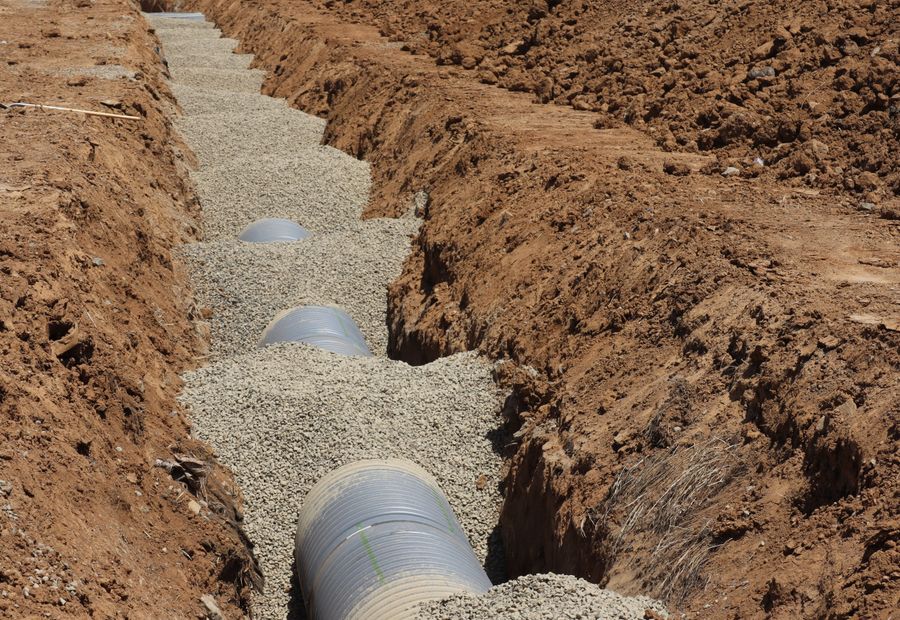
New systems here go in as Infiltrator Quick4 chambers on a level bottom, as pipe bedded in washed drainage stone under fabric, or as pressure distribution laterals fed by a pump where the design calls for even dosing. Tanks are precast concrete on sites a boom truck can reach. Risers bring both lids to grade at the finish, so the first pumping does not start with a shovel and a metal probe. Every trench bottom is instrument-level before anything is set in it, because a bottom that falls half a foot across its run loads one end and starves the other.
The Sequence, Start to Finish
Soil work first. Pits or borings, texture, layering, wetness, depth to rock. Then the design that the soil result allows, then the county permit and the authorization to construct. Then the dig. Then the county looks at open work before it gets covered. Then backfill, final grade, seed, and straw. Nothing in that order is optional and nothing skips ahead.
What You Decide, and When
Early, before the soil work: where the house sits, where the drive runs, and how many bedrooms. Those three fix everything downstream. Mid-project: tank material, chamber against stone, riser locations, and whether the reserve area is going to be protected or paved. Late: finish grade and seeding. Homeowners who get involved at the first stage save real money. Homeowners who move the house after the soil work pay for the soil work twice.
Building on Raw Mountain Land
Test before you close, not after. A tract with no answer on soil depth is a tract that may not carry a house of the size you have drawn. Around here the buildable ground is side slope, and depth to rock changes across a single parcel, so the answer for the flat spot by the road tells you nothing about the bench up top.
Booking
We evaluate, design, and permit year round. Digs happen when the site is workable, and a saturated slope moves a start date rather than risking a smeared trench bottom. Call (828) 528-7231 before the house is staked.
What size septic tank does my house need?
Bedroom count sets it, not square footage and not how many people live there now. The reasoning is that a bedroom is what the next owner will use, and a system outlives an owner. A three bedroom house and a five bedroom house on identical soil get different tanks and different field sizes. Your county sets the minimum for each count. Adding a bedroom later means going back and sizing the system up, which is worth knowing before framing goes in.
How long does a septic system installation take?
The digging is the short part. On a straightforward site the tank, lines, and field go in within a few days, and backfill and grading follow. What takes the time is everything before the machine arrives: pits or borings, someone reading the soil, the design, and the county issuing the authorization to construct. Plan that in months rather than days, and start it early, because a building permit will not come through until the septic authorization is in hand.
Do I need a septic system if there is no sewer on my road?
In North Carolina a residence or business that is not served by public sewer has to have an approved on-site wastewater system. That is the whole reason this trade exists out here. The sewer district around Asheville covers the city and several towns plus certain unincorporated pockets, and it stops where the collector mains stop. Plenty of Buncombe County sits past that line, and most of Madison County never had the option.
Gravity or pump: which one will my site need?
The ground picks. Gravity works when there is enough fall from the tank to the field and enough clean soil depth under the trenches. It has no moving parts and nothing to fail, which is why we use it wherever the site allows. A pump with pressure laterals is needed when the field sits above the tank, when the design calls for even dosing across the whole field, or when the site would not support a gravity trench field at all. A pump adds a panel, an alarm, and a service item.